godaddy • ai • regulated ux • optimization
A2P Registration Optimization
Increasing A2P registration approval rates from 4% to 52%
Role
Lead UX Designer
Year
2026
Context
GoDaddy offers business phone numbers that allow small businesses to call and text customers using a dedicated business line.
Before customers can send text messages, however, U.S. wireless carriers require them to complete A2P (Application-to-Person) registration through The Campaign Registry (TCR). The process verifies that businesses are legitimate and helps reduce spam across carrier networks.
Although GoDaddy owned the registration experience, we did not control the requirements. Every application ultimately had to satisfy Twilio and TCR's review criteria, which changed frequently and often without notice.
We originally launched an A2P registration experience in 2023, achieving approval rates of around 60%. However, in December 2025, Twilio and The Campaign Registry significantly tightened their review standards. Almost overnight, approval rates dropped to as low as 0–2%, leaving many legitimate businesses unable to text their customers.
In April 2026, we revisited the experience with a new goal: dramatically improve approval rates without changing the information required by Twilio or TCR.
The Problem
Every rejected application created more than just frustration.
Businesses often waited up to 15 days to learn their application had been rejected, only to discover they needed to restart the process with little guidance.
Because customers experienced the registration through GoDaddy—not Twilio or TCR—the frustration was directed at us through App Store reviews, NPS feedback, and support channels.
Our challenge wasn't simply improving a form.
How might we dramatically increase approval rates without changing the information required by Twilio and TCR?
Research
To understand where we could meaningfully improve approval rates, I focused on two areas.
Competitive analysis
I evaluated competing A2P registration experiences, including Quo (formerly OpenPhone), to understand how other providers reduced customer effort while satisfying the same regulatory requirements.
Several opportunities emerged:
- Save progress and return later.
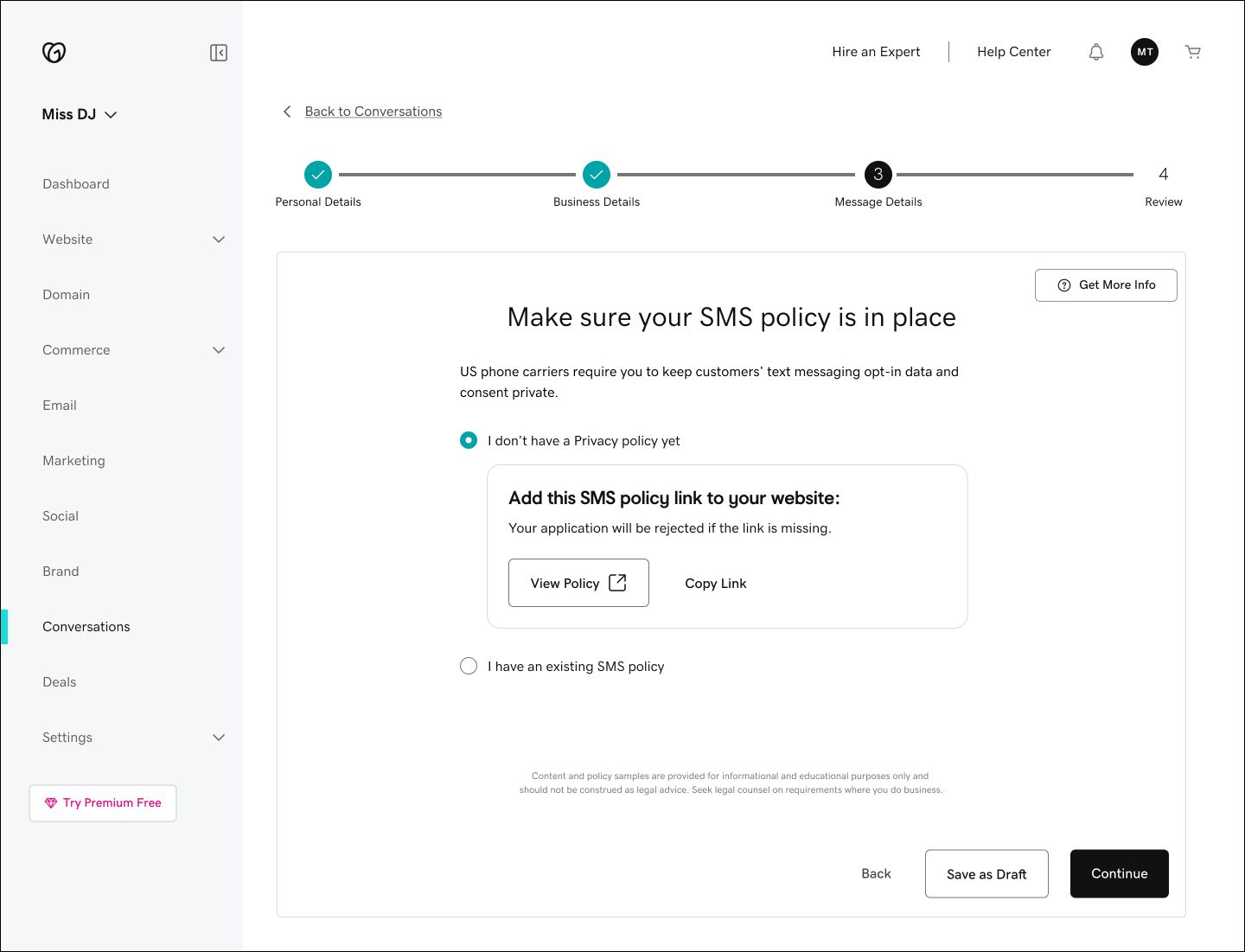
- Generate SMS privacy policies automatically.
- Generate consent language for customer websites.
- Replace long-form messaging examples with structured questions and AI-generated outputs.
- Provide significantly more guidance around consent requirements.
Rejection analysis
Next, I partnered with the team to analyze the most common rejection reasons returned by Twilio.
Rather than treating every rejection equally, we grouped them into themes to identify where the biggest opportunities existed. Applications consistently failed for reasons like:
- Business information
- Campaign and use case descriptions
- Customer consent
- SMS message examples
Together, these two activities revealed the same pattern from different directions: competitors weren't asking users to become A2P experts, and neither should we.
Key Insights
Customers weren't struggling because the registration required too much information.
They were struggling because they were being asked to create information they didn't know how to write.
Examples included:
- SMS privacy policies
- Terms of service
- Message examples
- Consent disclosures
- Campaign descriptions
Instead of asking customers to become A2P experts, we realized we could use AI to generate much of this content using business information GoDaddy already knew about them.
Final Design
Rather than removing required fields—which wasn't possible—I focused on reducing the amount of work customers needed to do themselves.
Throughout the experience, AI transformed existing business information into registration-ready content.
Generating SMS privacy policies and Terms of Service instead of asking customers to write legal content from scratch.
Generating compliant SMS message examples based on the customer's business type and intended texting use cases.
Generating website consent disclosures for businesses that weren't comfortable publishing their business phone number before approval by creating a preview image showing exactly how the disclosure would appear once activated.
Prefilling information wherever GoDaddy already had reliable business data, reducing duplicate data entry.
The result was an experience that still collected every field required by Twilio while dramatically reducing the amount of work customers had to complete manually.
Impact
The redesigned experience launched in mid-June 2026.
Our initial goal for this first iteration was to increase first-time approval rates from 4% to 20% while laying the foundation for future improvements.
Within two months, we far exceeded that goal:
- Application approval rates increased from 4% to 52%.
- More than doubled our original target of 20%.
- The highest-frequency rejection categories were significantly reduced.
- We established an ongoing optimization process, using rejection data to continuously identify opportunities where AI could reduce customer effort while improving submission quality.
The work is still ongoing, with a long-term goal of increasing first-time approval rates to 80%.
Reflection
This project fundamentally changed how I think about designing within external constraints.
Good UX isn't always about making something simpler.
Sometimes it's about intelligently removing work while still satisfying complex requirements that you don't control.
By combining competitive research, rejection analysis, and AI-assisted content generation, we transformed an experience that was failing nearly every applicant into one that dramatically improved first-time approval rates—without changing a single requirement imposed by Twilio or The Campaign Registry.