asurion • contextual research • sales enablement • internal tools
GLOW
Transforming an enrollment tool into a real-time sales coach
Role
Lead UX Designer
Year
2023
Context
Asurion Home+ was designed to protect customers' connected home devices, but selling the product depended heavily on call center experts who were primarily hired for technical support—not sales.
GLOW existed to help experts enroll customers into Home+, but over time it had evolved into more of an enrollment tool than a sales tool. It provided information once a customer had already agreed to purchase, but offered little guidance on how to naturally lead someone to that decision.
Our goal was simple: increase Home+ enrollments by helping experts become more successful at selling.
The Problem
Research showed that new experts generally came from one of two backgrounds: sales or technical support.
Experts with sales experience had plenty of resources to learn technical support. Experts with technical backgrounds had very little support learning sales.
Ironically, they were expected to do both jobs simultaneously—solve complex technical problems while recognizing sales opportunities and confidently introducing a product many weren't comfortable selling.
How might we help experts with little or no sales experience feel more confident introducing and selling Home+?
Research
Rather than immediately redesigning GLOW, I wanted to understand how experts actually worked.
Together with a UX researcher, I spent two days embedded in Asurion's Phoenix call center conducting contextual inquiry, individual interviews, observations, and co-creation workshops with experienced experts.
At the same time, I facilitated stakeholder workshops to align leadership around GLOW's future. Instead of collecting feature requests, I asked stakeholders to evaluate where they believed GLOW was today versus where they wanted it to be in the future across a series of competing priorities—such as Enable sales ↔ Improve sales, Everything available at once ↔ Focus on one thing at a time, and Take rate ↔ Churn rate.
The largest gaps between today's state and the desired future state revealed our biggest opportunities.
Key Insights
Spending time in the call center fundamentally changed how we viewed the product.
Selling and solving compete
Experts naturally viewed themselves as problem solvers first. The most successful sellers didn't treat Home+ as a separate sales pitch—they positioned it as another way of solving the customer's problem.
The best sellers collect “breadcrumbs”
Successful experts constantly listened for small details customers mentioned throughout the call—children in the background, working from home, gaming consoles, smart thermostats. These “breadcrumbs” allowed them to personalize their pitch naturally instead of delivering the same script to everyone.
GLOW wasn't teaching people how to sell
Experienced experts rarely relied on GLOW. Instead, they leaned on experience, coaches, coworkers, and personal techniques. Ironically, GLOW itself wasn't reinforcing the sales methodology it was named after.
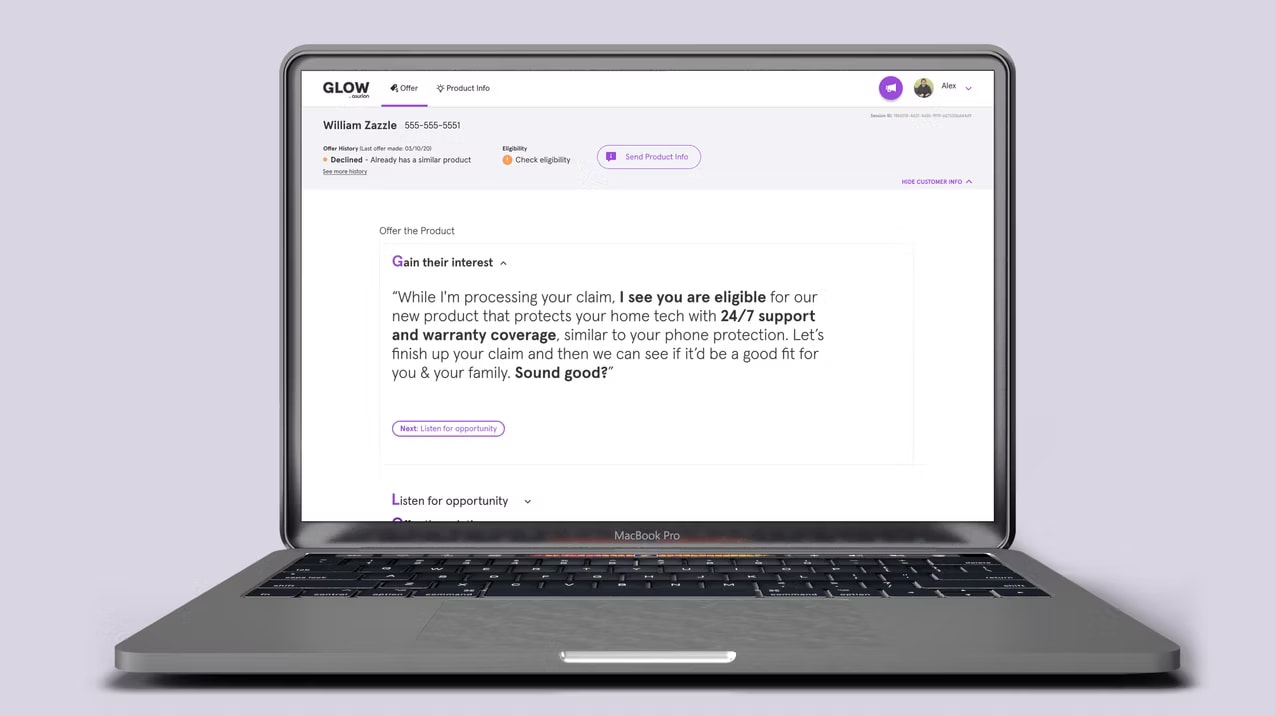
Final Design
The research led us to rethink GLOW entirely.
Rather than exposing every sales tool simultaneously, I redesigned the experience around the existing GLOW sales framework:
- Gain their interest
- Look for opportunity
- Offer the solution
- Win the customer
Instead of acting as a static reference library, GLOW became a conversational coach that progressively surfaced the right guidance at the right moment.
To make the guidance as effective as possible, I partnered with sales enablement teams to analyze successful sales calls and identify the language most consistently used by top-performing experts. I also conducted highlighter tests with consumers to identify the messaging that resonated most strongly, allowing us to refine scripts using language customers actually found compelling.
Impact
Following a pilot rollout, I conducted qualitative interviews with team coaches to understand how experts were using the new experience beyond what analytics alone could tell us. The results validated the new direction.
- Experts became significantly better at identifying and using customer “breadcrumbs” to personalize conversations.
- One expert improved from roughly 1 sale per 100 offers to at least 1 sale per day using the guided workflow.
- One pilot team’s offer rate increased from 59.6% to 73%.
- Sales per 100 offers increased from 2.1 to 4.2 during the pilot.
- Overall pilot metrics outperformed the control group and established a strong foundation for future iterations.
Reflection
Before this project, I believed improving a sales tool meant giving people better information.
This research showed me something different. People rarely struggle because information is unavailable. They struggle because they don't know what information matters in the moment.
By combining contextual research, stakeholder alignment, and iterative design, we transformed GLOW from a product that simply enabled enrollment into one that actively coached experts through successful sales conversations.