asurion • systems thinking • mobile • user research
Appliance+
Designing a smarter way to identify and register home appliances.
Role
Lead Designer
Year
2021
Context
In Q1 of 2021, I joined Asurion's Device Collection team as the lead designer. Our team was responsible for creating a single, scalable experience that could be reused anywhere customers add and manage devices across Asurion's ecosystem—including mobile devices, smart home products, and appliances.
At the same time, Asurion was expanding beyond mobile protection with the launch of Appliance+, a subscription service that protects household appliances after their manufacturer warranties expire. The success of the product depended on one critical first step: getting customers to register the appliances they owned.
I was responsible for designing the end-to-end appliance registration experience and appliance details page, creating a foundation that the Appliance+ team could build upon while ensuring the experience could scale to future device categories.
The Problem
Registering an appliance sounds straightforward.
In reality, it requires customers to locate model and serial numbers hidden throughout their home—information most people have never needed before.
If the registration process felt frustrating, confusing, or overly time-consuming, customers would experience friction before receiving any value from the product.
At the same time, the experience needed to balance two competing goals: collect enough information for Asurion to provide meaningful value, and minimize the effort required from customers.
Designing for Appliance+ also meant designing for the future. The patterns established here needed to work just as well for other products that would eventually share the same registration framework.
Research
Before designing anything, I wanted to understand two things:
- What information did we actually need from customers?
- How difficult was it for someone to collect that information?
Working with the Appliance+ product team, I mapped every piece of information we planned to collect back to the value it would provide. This exercise helped us prioritize what was truly necessary for the MVP instead of asking customers for information simply because we could.
To better understand the customer experience, I recruited several coworkers and asked them to locate the model and serial numbers for every eligible appliance in their homes while timing themselves.
The average participant successfully collected information for roughly six appliances in around three minutes. More importantly, the exercise surfaced several unexpected insights:
- People assumed the task would be much harder than it actually was.
- Accessibility could become a challenge for appliances with hard-to-reach labels.
- Older appliances might have damaged or faded product stickers.
- Customers weren't always sure which appliances qualified for coverage.
While participants searched for their appliance information, I also asked them to photograph each product sticker. The labels varied dramatically in layout and formatting, revealing an opportunity for a future AI-assisted experience that could automatically extract model and serial numbers from a photo instead of requiring manual entry. Although that capability wasn't feasible for the initial release, understanding the problem early helped shape future thinking.
Key Insights
The research challenged several assumptions we had made before designing the experience.
- Registering appliances wasn't as burdensome as expected once users got started.
- The biggest friction wasn't collecting information—it was knowing where to find it.
- Customers needed confidence that providing detailed information would result in tangible value.
- The registration experience needed to accommodate both today's MVP and future automation opportunities.
These insights became the foundation for the registration flow.
Final Design
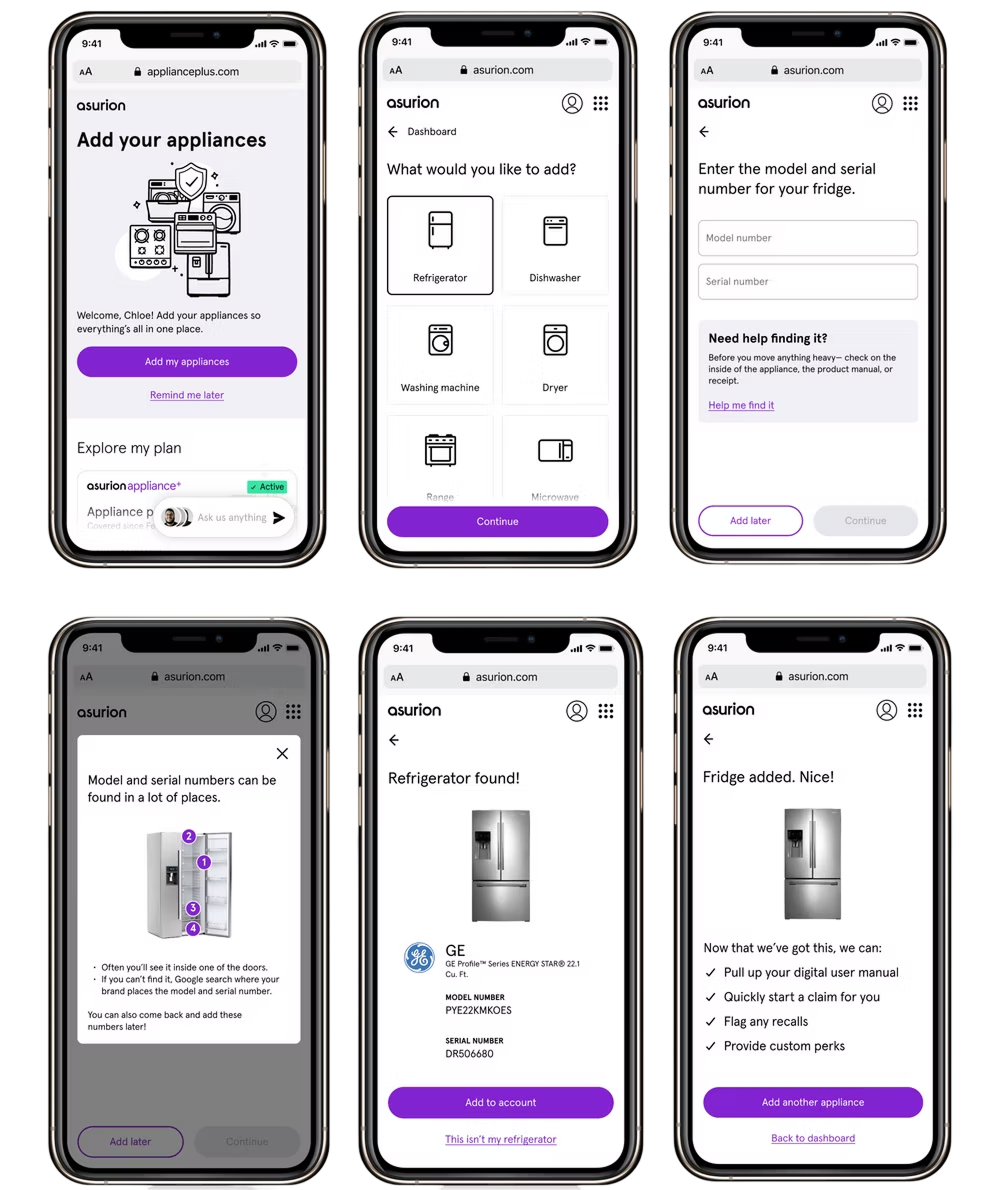
Using the research findings, I mapped the end-to-end registration journey and identified what was truly necessary for an MVP.
Rather than trying to support every possible scenario from day one, I intentionally simplified the experience by focusing on the information customers needed to successfully register a single appliance. Lower-priority functionality—such as adding multiple appliances in one session—was deferred in favor of a faster, more approachable experience.
Working within Asurion's design system and collaborating closely with the design systems team where new patterns were needed, I designed a registration flow that could scale beyond Appliance+ to support future device categories across Asurion's ecosystem.
The experience guides customers through registration one step at a time, progressively collecting appliance information before confirming the detected appliance and immediately demonstrating the value of registration through access to manuals, recalls, warranty information, claims, and future product features.
User Testing
To validate the experience, I conducted usability testing with an interactive prototype to understand whether customers could successfully register an appliance and identify any points of friction throughout the flow.
Overall, participants were able to complete the registration process with little difficulty, but the testing uncovered two key opportunities for improvement.
Keep primary actions visible
Users expected selecting an appliance type to automatically advance them through the flow and often missed the Continue button because it appeared below the fold. To address this, I made the primary action sticky so it remained visible throughout the selection process.
Ask instead of assume
Participants were comfortable providing their appliance brand when asked directly. Attempting to infer information on the user's behalf introduced unnecessary complexity without improving the experience, reinforcing that a simple, transparent interaction was the better design choice.
These changes made the flow more intuitive while maintaining user confidence throughout the registration process.
Reflection
This project reinforced that registration experiences aren't simply about collecting information—they're about earning enough trust for customers to provide it.
The research helped us focus on the right problems before investing heavily in design, while usability testing demonstrated that users valued transparency over "smart" automation when confidence was low.
Although the flow wasn't ultimately launched during my time on the team, the work established a scalable foundation for Appliance+ while informing how device registration could evolve across Asurion's broader ecosystem.